


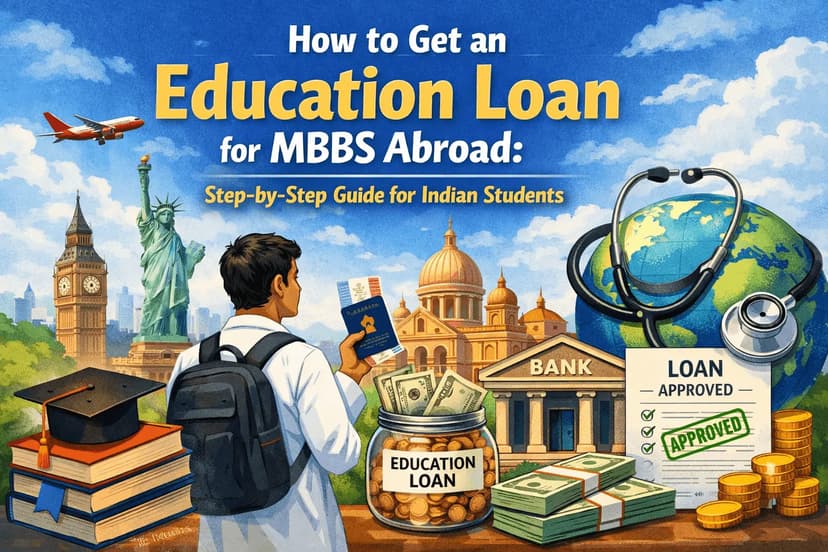
Introduction
While studying MBBS abroad in countries like Kazakhstan, Russia, or Georgia is vastly cheaper than securing a private medical seat in India, a budget of ₹20 Lakh to ₹40 Lakh is still a monumental investment for most Indian families. Fortunately, Indian public and private sector banks are highly supportive of international medical education, provided the university is recognized. Securing that loan, however, requires careful preparation. Here is the definitive 2026 guide to smoothly securing your MBBS education loan.
1. Basic Eligibility for an Education Loan
Banks want assurance that the student is a legitimate candidate and the institution is recognized. The applicant must be an Indian citizen, possessing a valid admission letter from a reputable, NMC and WHO-approved foreign medical university. The co-applicant (usually a parent or guardian) must demonstrate a stable income and a healthy CIBIL (credit) score.
2. Knowing Your Loan Options: Public vs. Private Banks
Public sector banks (like SBI, PNB, or Bank of Baroda) offer lower interest rates (typically 9% - 11%) and longer repayment tenures, but the paperwork process is stringent and can be slow. Private banks and NBFCs (like HDFC Credila or Avanse) process loans much faster and offer flexible collateral terms, though their interest rates might be slightly higher (11% - 14%).
3. Secured vs. Unsecured Loans
For loan amounts under ₹7.5 Lakhs, most banks do not require tangible collateral (unsecured loans). However, for the large amounts required for an MBBS abroad (₹15 Lakhs to ₹40 Lakhs), banks mandate 'collateral security' (secured loans). Collateral can be residential/commercial property, fixed deposits, LIC policies, or government bonds equal to or slightly higher than the required loan amount.
4. Expenses Covered Under the Loan
A well-structured education loan covers almost the entire cost of the journey. This includes direct tuition fees, university hostel charges, library/laboratory fees, examination fees, and mandatory health insurance. In many cases, it also covers travel expenses (flight tickets) and a portion of daily living expenses.
5. Margin Money (Down Payment)
Banks rarely fund 100% of the cost for studies abroad. They usually mandate a 'Margin' of 15% to 20%. This implies that if the total estimated cost is ₹30 Lakhs, the bank will fund 85% (₹25.5 Lakhs), and the family must demonstrate they possess the remaining 15% (₹4.5 Lakhs) directly.
6. Step 1: Secure Your Admission Letter
You cannot apply for a loan based on an intention. The core document for opening a bank file is the official 'Admission Letter' along with an exact, verified 'Fee Structure' provided by the foreign university. Without these, no bank will process an education loan.
7. Step 2: Gather Required Documentation
A hefty file must be prepared. Student docs include KYC (Aadhar/PAN), Passport, 10th/12th mark sheets, NEET scorecard, and admission letters. Co-applicant docs require their KYC, last 6 months' bank statements, 3 years of ITR returns, and salary slips/business proof. Collateral documents require original property titles, registered valuations, and non-encumbrance certificates.
8. Step 3: Bank Review, Valuation, and Sanction
Once submitted, the bank evaluates the co-applicant's financial health. If property is pledged, bank-approved lawyers and valuers verify the legal standing and market price of the collateral. If everything is clear, the bank issues a 'Sanction Letter' formally approving the loan amount.
9. Step 4: Disbursement Process
Banks do not hand large sums of cash to the student. The tuition fees are disbursed electronically directly to the foreign university’s authorized international bank account at the beginning of each academic year or semester. Living expenses, if approved, are deposited onto a forex card for the student.
10. Repayment Terms (Moratorium Period)
One of the greatest benefits of education loans is the 'Moratorium Period'. Repayments (EMIs) do not begin while the student is studying. The EMI phase typically starts 6 months to 1 year AFTER the completion of the 6-year MBBS degree, or once the student secures employment (whichever is earlier), giving them time to clear FMGE and stabilize.
Conclusion
Navigating bank processes for an international medical education loan can be exhausting if you lack the right paperwork. By securing a legitimate admission from an NMC-approved university, keeping financial records in check, and presenting clean collateral, Indian parents can comfortably fund their child’s MBBS abroad. Proper advanced planning is the absolute key to success.
Need Help With University Admission and Loan Guidance?
Imperial Overseas Consultants provides verified admission letters and fee break-ups designed perfectly for Indian bank loan formats. Contact us to kickstart your stress-free admission and funding journey.
Get Expert Loan GuidanceFrequently Asked Questions (FAQs)
Can I get a loan without collateral for MBBS abroad?
Generally, no. Because the amount required exceeds ₹7.5 Lakhs, almost all banks and NBFCs will require tangible collateral like property or high-value Fixed Deposits.
Does the bank pay for my living expenses and flights?
Yes, most comprehensive education loan policies cover hostel accommodations, health insurance, and essential travel costs, but living expenses must be estimated reasonably.
When do I need to start paying back the loan?
The EMIs begin after the 'Moratorium Period' ends, which is usually the course duration (6 years) plus an additional 6 to 12 months grace period.
Similar Posts

Imperial Overseas Consultants – Pathankot's Most Trusted MBBS Abroad & Study Visa Experts
By Imperial Overseas Consultants
5/1/2026 | 12 min read
How to Identify a Genuine MBBS Abroad Consultant in Punjab – Red Flags & Checklist 2026
By Imperial Overseas Consultants
5/5/2026 | 14 min read

Study MBBS in Russia 2026 – Complete Guide for Indian Students: Fees, Universities & Admission
By Imperial Overseas Consultants
5/7/2026 | 13 min read